Best State for a Non-Resident LLC
Wyoming, Delaware, and New Mexico compared, plus how to actually choose. Last reviewed: July 2026.
Search “best state for a non-resident LLC” and every result hands you a different answer. That is because there is no single best state. The right choice depends on how your business operates, what you are willing to pay each year, and whether you value privacy or investor credibility more. This guide compares the three states non-residents consider most, shows what each actually costs and offers, and gives you a way to decide. If you want the full formation process first, start with our guide to forming a U.S. LLC as a non-resident.
CrossPoint is not a bank, law firm, or tax advisor. This is general information, not legal or tax advice. State fees change often, so confirm current figures on the relevant Secretary of State website before you file.
The rule that overrides state choice
Before comparing states, understand the one factor that beats all of them. If your business has a real physical presence in a U.S. state, where you keep an office, store inventory, or employ people, you generally register in that state, not a “better” one elsewhere. Forming in Wyoming while operating in California does not avoid California; it usually means registering as a foreign LLC in California too, and paying both sets of fees. State choice is a real decision only when your business has no physical footprint in any single state, which is the case for most fully remote founders. If that is you, read on.
Wyoming
Wyoming is the option most remote non-residents look at first. It has no state income tax, low formation and annual costs, and it does not list member names in public records, so ownership stays private. The filing fee is modest and the annual report carries a small license tax based on assets located in Wyoming, which is minimal for a company with no Wyoming assets. At the fees published in July 2026, that means a $100 filing fee (about $102 online) and an annual report license tax with a $60 minimum; confirm current figures on the Wyoming Secretary of State site. Wyoming suits a lean, online, owner-operated business that wants low cost and privacy.
New Mexico
New Mexico is usually the lowest ongoing cost of the three. Its defining feature is that it requires no annual report and no annual fee for an LLC, so after the one-time filing there is little recurring paperwork. At the fees published in July 2026, the filing fee is $50, and nothing recurs at the state level; confirm on the New Mexico Secretary of State site. It also keeps member names off the public record. The trade-off is that New Mexico carries less name recognition than Wyoming or Delaware, which rarely matters for a small remote business but can matter if you want a state that investors or partners recognize.
New Mexico does not require an LLC annual report or annual fee to the Secretary of State. Separate tax-return, withholding or registration obligations may still arise depending on the entity’s federal tax classification, registration, business activity and New Mexico-source income. A New Mexico CPA should confirm the position for the particular company.
Delaware
Delaware is the state to consider when you plan to raise investment. It has a well-developed body of business law and a dedicated business court, which is why venture-backed startups and companies issuing shares favor it. That credibility comes at a cost: at the fees published in July 2026, the filing fee is $110 and every Delaware LLC pays a flat $300 annual franchise tax, due June 1 each year, regardless of income; confirm on the Delaware Division of Corporations site. Delaware also offers less owner privacy than the other two. If you are a solo founder running a service or e-commerce business with no plans to raise capital, Delaware’s advantages may not apply to you.
States non-residents usually skip
A few states come up because they are famous, not because they fit a remote foreign founder:
- Nevada markets itself as tax-friendly, but it layers on a business-license fee and an annual list filing that push its yearly cost above Wyoming and New Mexico.
- California charges an $800 minimum annual franchise tax on LLCs, which applies even at low income. Consider it only if you actually operate there.
- New York requires new LLCs to publish formation notices in two newspapers, which adds hundreds of dollars in cost. Again, only worth it if you operate in New York.
What about the other 47 states?
Nothing stops a non-resident from forming in any state; none of them imposes a residency requirement on LLC owners. The shortlist forms around three states because, for a founder with no U.S. footprint, the deciding factors are recurring cost, privacy, and legal infrastructure, and Wyoming, New Mexico, and Delaware sit at the useful extremes of those trade-offs. Most other states offer some middle combination at a middle price without a distinct advantage for a remote owner. The exception is simple: if you actually operate somewhere, that state picks itself, whatever its fees, and the comparison below stops applying to you.
Best state for a non-resident LLC: side-by-side comparison
| Factor | Wyoming | New Mexico | Delaware |
|---|---|---|---|
| Recurring cost | Low annual report | Lowest: no annual report | Higher: franchise tax |
| State income tax | None | Applies to in-state income | None on out-of-state income |
| Best fit | Lean remote business | Lowest-maintenance setup | Raising investment |
Exact fees change. Confirm current amounts on the official Wyoming, New Mexico, or Delaware Secretary of State website before filing.
What five years actually costs
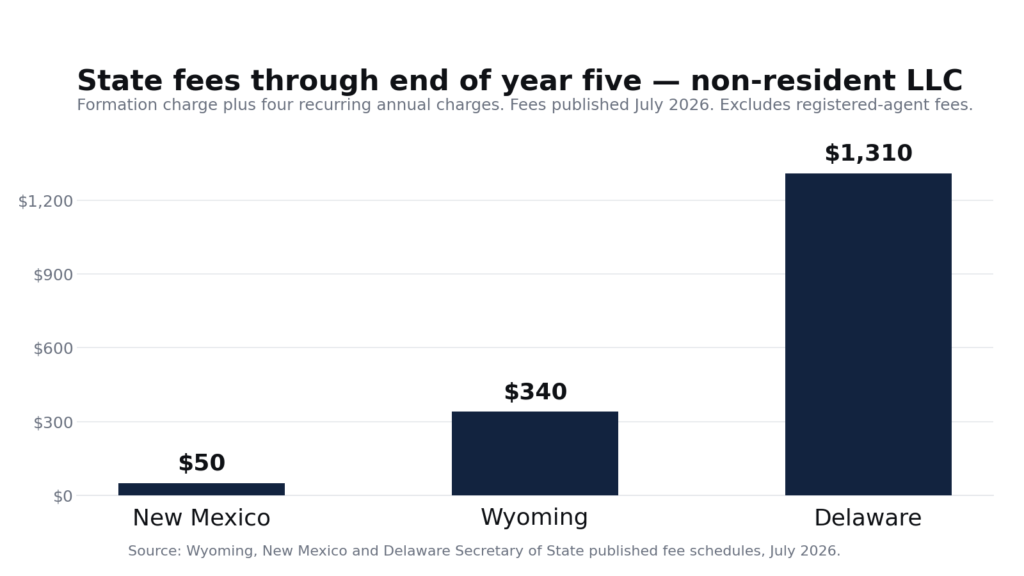
Yearly fees feel small until you multiply them. To compare the first five operating years consistently, the table below counts the formation charge plus four recurring state charges that become due during years two through five. Fees are those published by each state as of July 2026. These are state charges only. Each of these states also requires a registered agent. Provider fees vary and are excluded from this comparison because they are not state charges.
| Wyoming | New Mexico | Delaware | |
|---|---|---|---|
| Filing fee (one-time) | $100 | $50 | $110 |
| Recurring state cost | $60 minimum per year | $0 | $300 per year |
| State fees through end of year five | ≈ $340 | ≈ $50 | ≈ $1,310 |
New Mexico has no recurring Secretary of State annual-report fee for an LLC. Wyoming’s recurring cost stays low. Delaware’s annual tax makes its five-year total close to four times Wyoming’s — a premium that is rational if Delaware’s legal infrastructure serves your plans, and overhead if it does not. Confirm the current fee amounts on the Secretary of State sites linked above before you rely on this table.
Two details behind the table. Wyoming’s annual filing is a license tax rather than a flat fee — see the note below on what drives it. Delaware’s $300 is due by 1 June each year regardless of your formation date, and missing it costs $200 plus 1.5% interest per month.
What drives Wyoming’s annual cost
Wyoming’s annual report is not a flat $60. It is a license tax of $60, or two-tenths of one mill ($0.0002) per dollar of assets, whichever is greater — calculated on assets located and employed in the state of Wyoming.
The arithmetic: $60 ÷ $0.0002 = $300,000. If an LLC has $300,000 or less in assets located and employed in Wyoming, the $60 minimum applies. Above that the formula governs — $1,000,000 of Wyoming assets produces $200.
Revenue, company value and assets outside Wyoming do not enter this particular annual-license-tax calculation. For a business run remotely with no property, inventory or equipment physically in Wyoming, the $60 minimum is normally what applies. Filing online adds a card-processing fee of 2.4%, minimum $1.
This calculation is frequently misstated as a revenue threshold or a worldwide-asset threshold. It is neither.
Wyoming LLC vs New Mexico LLC
Most non-resident founders who rule out Delaware end up choosing between these two. Here is the head-to-head that decides it.
| Factor | Wyoming LLC | New Mexico LLC |
|---|---|---|
| Formation fee | $100, approximately $102 online | $50 |
| Annual report | Required; $60 minimum annual license tax | No state annual report or annual fee |
| Member-name privacy | Strong in the standard public filing | Strong in the standard public filing |
| Five-year state cost | Approximately $340 | Approximately $50 |
| Generally fits | Founders wanting low costs, privacy and broader familiarity | Founders prioritizing the lowest recurring state cost |
These estimates use state fees published in July 2026 and exclude registered-agent charges. Privacy is not absolute: other registrations, licenses or legal requirements may disclose additional information. Confirm current fees and requirements with the relevant state before filing.
Charging-order protection, in plain terms
You will see this phrase in every state-comparison thread, usually without an explanation. A charging order is a court remedy that limits what a member’s personal creditor can take from an LLC: instead of seizing the company or its assets, the creditor is generally limited to receiving distributions that would have gone to that member. How strong that limitation is, and whether it fully applies to a single-member LLC, varies by state.
Wyoming is frequently cited because its statute extends charging-order protection to single-member LLCs explicitly. Delaware’s protection is well developed, with more of the discussion focused on multi-member companies. New Mexico follows more standard rules. Two honest cautions before this factor drives your choice: first, courts weigh facts, and how a company is actually run matters as much as where it was formed; second, if asset protection is a primary reason you are forming a company, that is a conversation for a licensed attorney who can see your whole situation, not a decision to make from comparison tables, ours included.
Name recognition with banks and payment platforms
One soft factor worth knowing about. Verification teams at financial institutions and payment platforms process Wyoming and Delaware paperwork constantly, so those documents are familiar territory. New Mexico companies are less common, which sometimes just means a reviewer takes a closer look at unfamiliar paperwork. To keep this in proportion: each institution applies its own requirements and makes its own decision whatever state you form in, and the state on your documents does not decide whether an application is approved. Complete, well-organized documentation matters far more than the state name at the top of it.
Does the state change my taxes?
This is where a common myth causes real mistakes. Forming in a “no income tax” state does not remove your U.S. federal tax. If your LLC earns income that is effectively connected to a U.S. trade or business, that income is taxed at the federal level regardless of which state you filed in. State choice mainly affects state-level fees, privacy, and paperwork, not your federal position. Forming a U.S. LLC also does not make you a U.S. tax resident. Because tax depends on your specific structure and where your income comes from, confirm your situation with a qualified professional rather than choosing a state to “avoid tax.”
How to decide in four questions
- Do you operate physically in one U.S. state? If yes, form there. If no, you have a free choice.
- Will you raise investment or issue shares? If yes, Delaware is worth its higher cost. If no, it usually is not.
- Do you want the lowest possible recurring cost? New Mexico, with no annual report, tends to win.
- Do you want a balance of low cost, privacy, and recognition? Wyoming is the common middle choice.
Not sure which fits your business?
Our formation service helps non-residents form in Wyoming, Delaware, New Mexico, and other states, handling the filing, registered agent, and federal tax account setup.
Frequently asked questions
Which state is best for a non-resident LLC?
For many remote, owner-operated businesses without a physical U.S. presence, Wyoming offers a practical balance of low ongoing costs, privacy and familiarity. New Mexico may be better when minimizing recurring state costs is the main priority, while Delaware generally fits companies planning to raise institutional investment. If the business operates physically in a particular state, that state may be the appropriate formation location.
Is Wyoming really the best state for a non-resident LLC?
It is a common choice for lean remote businesses because of its low cost and privacy, but it is not automatically best. New Mexico can cost less to maintain, and Delaware fits founders raising investment.
Which state is cheapest for a non-resident LLC?
New Mexico is usually the lowest ongoing cost because it requires no annual report or annual fee after formation. Wyoming is also inexpensive. Delaware costs more because of its franchise tax.
Can I form in a low-tax state to avoid U.S. tax?
No. Federal tax on income connected to a U.S. trade or business applies regardless of the state you form in. State choice affects state fees and privacy, not your federal tax. Get advice for your situation.
What if I do business in a different state than where I form?
If your LLC has a physical presence, employees, or operations in another state, you may need to register there as a foreign LLC and meet that state’s requirements and fees.
Can I move my LLC to another state later?
Sometimes. Some states allow “domestication,” which moves an existing LLC in; otherwise the route is dissolving in one state and re-forming in another. Both cost filing fees and paperwork, which is exactly why it is cheaper to answer the four questions above carefully the first time.
Which state is best for e-commerce?
The same four questions apply. E-commerce run remotely without U.S. inventory usually points toward the low-recurring-cost, high-privacy states, while a company planning to raise investment points toward Delaware. Note that storing inventory in a U.S. warehouse can create obligations in the state where the inventory sits, which is a question for a professional who can look at your setup.
Does the state affect opening a bank account?
Banks apply their own requirements regardless of your formation state. The state you choose does not decide whether an account is approved. See the banking section of our main US LLC guide.
About this guide. Written and maintained by the CrossPoint Formations team. Last reviewed July 2026. Fee figures come from the Secretary of State pages linked above; if you spot something out of date, tell us on WhatsApp and we will check it.
Ready to compare packages? See our pricing. CrossPoint Formations Inc. is a private business-formation service, is not affiliated with any government agency, and is not a bank, law firm, or tax advisor.